
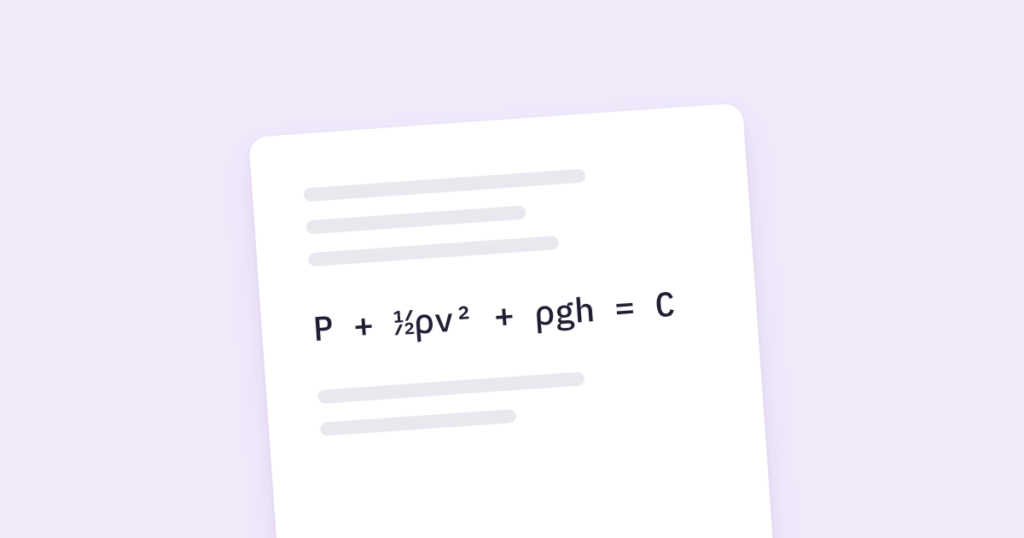
Most explanations of Bernoulli’s equation either skip the derivation or bury it in calculus. This one does neither. By the end you will know where each term comes from, when the equation is safe to use, and how to recognise the situations where it quietly gives you a wrong answer.
New words
The terms this page uses, each with a plain meaning and an everyday picture.
Streamline
The path one small parcel of fluid follows. Bernoulli compares two points on the same one.
The route a leaf takes down a smooth stream.
Static pressure P
How hard the fluid pushes on the pipe wall. What a pressure gauge reads.
How hard a balloon pushes back on your hands.
Dynamic pressure ½ρv²
Energy per cubic metre that the fluid has because it is moving.
The push of the wind on your palm out of a car window.
Hydrostatic pressure ρgh
Energy per cubic metre that the fluid has because of its height.
Water in a tower on the hill can run down to every tap.
Continuity A₁v₁ = A₂v₂
What goes in must come out, so where the pipe narrows the same flow must move faster.
A crowd speeding up to get through a narrow door.
Head loss hL
Energy lost to friction, written as metres of fluid. Plain Bernoulli has no term for it.
A long garden hose gives a weaker jet than a short one.
It is a statement about energy, not about fluids
Take a small parcel of fluid moving along a streamline. It carries three kinds of energy per unit volume:
| Term | Name | What it is |
|---|---|---|
P | Static pressure | the pressure a gauge moving with the fluid would read |
½ρv² | Dynamic pressure | energy the parcel has because it is moving |
ρgh | Hydrostatic pressure | energy it has because of its height |
If nothing adds energy and nothing takes it away, the total cannot change. That is the whole equation:
pressure energy + motion energy + height energy is the same at both points, as long as nothing adds or removes energy.
Every term has units of pascals. That is worth noticing, because it means you can compare them directly — and a quick comparison usually tells you which effect dominates before you calculate anything.
Where it comes from
Follow a short slug of fluid, volume V and mass m = ρV, as it moves along a streamline from point 1 to point 2. Three things happen to its energy, and they have to balance.
- Pressure does work on it. The fluid behind pushes it forward with P₁; the fluid ahead pushes back with P₂. The net work is (P₁ − P₂)V.
- Its kinetic energy changes by ½m(v₂² − v₁²) = ½ρV(v₂² − v₁²).
- Its potential energy changes by mg(h₂ − h₁) = ρVg(h₂ − h₁).
With no friction and no pump, the work done by pressure is exactly what pays for the other two:
the push from the pressure difference goes into speeding the fluid up and lifting it.
Divide every term by V and move each point’s terms to its own side:
That is the whole derivation. Each assumption in the table further down is one line of it: no friction (nothing else takes energy), steady and incompressible (the same volume enters and leaves), and one streamline (the same slug, start to finish).
A worked example: the pipe reducer
Water at 20 °C flows through a horizontal pipe that narrows from 100 mm to 50 mm. At the wide end the velocity is 2 m/s and the gauge pressure is 300 kPa. What is the pressure after the reducer?
Step 1 — find the downstream velocity
Bernoulli alone cannot do this. You need continuity first: the same mass of water per second has to pass every cross-section.
the same volume passes every section each second, so a narrower pipe means faster water.
The diameter halves, so the area drops to a quarter, so the velocity must go up by four:
Step 2 — apply Bernoulli
The pipe is horizontal, so the elevation terms cancel:
| ρ (water, 20 °C) | 998 kg/m³ |
| ½ρ(v₁² − v₂²) = 0.5 × 998 × (4 − 64) | −29.94 kPa |
| P₂ = 300 − 29.94 | 270.1 kPa |
|---|
The pressure dropped by about 30 kPa. This is the part that feels wrong the first time — squeeze a pipe and the pressure goes down, not up. But the fluid had to be accelerated from 2 to 8 m/s, and the only thing available to pay for that acceleration was its own static pressure.
Step 3 — now lift it 3 metres
Same reducer, but point 2 is now 3 m higher than point 1. The elevation term stops cancelling:
| Starting pressure P₁ | 300.0 kPa |
| Cost of speeding up | −29.94 kPa |
| Cost of lifting 3 m | −29.36 kPa |
| P₂ | 240.7 kPa |
|---|
Notice the two costs are almost identical here. Roughly speaking, lifting water 3 metres costs about the same as accelerating it from 2 to 8 m/s. That kind of sense-check is more valuable than the number itself.
The same example, straight out of the calculator:
# Bernoulli calculator · water · v₁ 2 → v₂ 8 m/s · h 0 → 3 m · run 20 Oct 2026
P₁   static pressure in         300.00 kPa
     ½ρ(v₁² − v₂²)  velocity     −29.94 kPa
     ρg(h₁ − h₂)    elevation    −29.36 kPa
P₂   static pressure out        240.7 kPa   ✓ matches Step 3
The Bernoulli calculator is preloaded with exactly this example. Change one input at a time and watch which term in the breakdown moves.
The four assumptions, and what breaks them
| Assumption | Broken by |
|---|---|
| Steady flow | pumps starting up, valves closing, water hammer |
| Incompressible | gases above roughly Mach 0.3 |
| Frictionless | long pipes, rough walls, bends, partly closed valves |
| Same streamline | comparing points across a separated or recirculating region |
Why a garden hose defeats it
Put your thumb over a hose and the water speeds up — Bernoulli predicts that. But try to calculate the pressure at the nozzle from the pressure at the tap and you will be badly out. Thirty metres of coiled hose has substantial friction loss, and the equation as written has no term for it.
The fix is not to abandon Bernoulli but to extend it. Add a head-loss term, hL, and you get the extended Bernoulli equation — which is what practising engineers actually use for pipework:
the same balance, with friction’s share added on the downstream side.
Using gauge pressure at one point and absolute pressure at the other. Pick one convention and hold it for the whole calculation. If the answer comes out negative, this is the first thing to check — before you conclude the flow cavitates.
Where to go next
Continuity and Bernoulli together will carry you through most introductory pipe-flow problems. The next thing worth learning is the Darcy–Weisbach equation, which is how hL above actually gets calculated.
Spotted an error in the maths?
Tell me and I will fix it and say so — send it through here